Measuring Climate Change Progress by Infrastructure Deployment Rather than Temperature
Measuring Climate Change Progress by Infrastructure Deployment Rather than Temperature
In a new video, Climate Targets MISSED. What happens now?, the Just Have a Think YouTube channel discusses a new paper about measuring climate change progress with clean energy targets, not temperature targets, “to avoid the insidious narrative of climate failure, which risks backlash and doomerism.” They go on:
“Although the 1.5°C Paris agreement cannot be saved, a tolerable and safe climate – in which humans and other species can thrive – is still achievable. This will result not from setting distant unachievable goals, but through a more modest approach: to produce enough extra clean energy each year to climb the climate ladder towards a safer future without fossil fuels.”
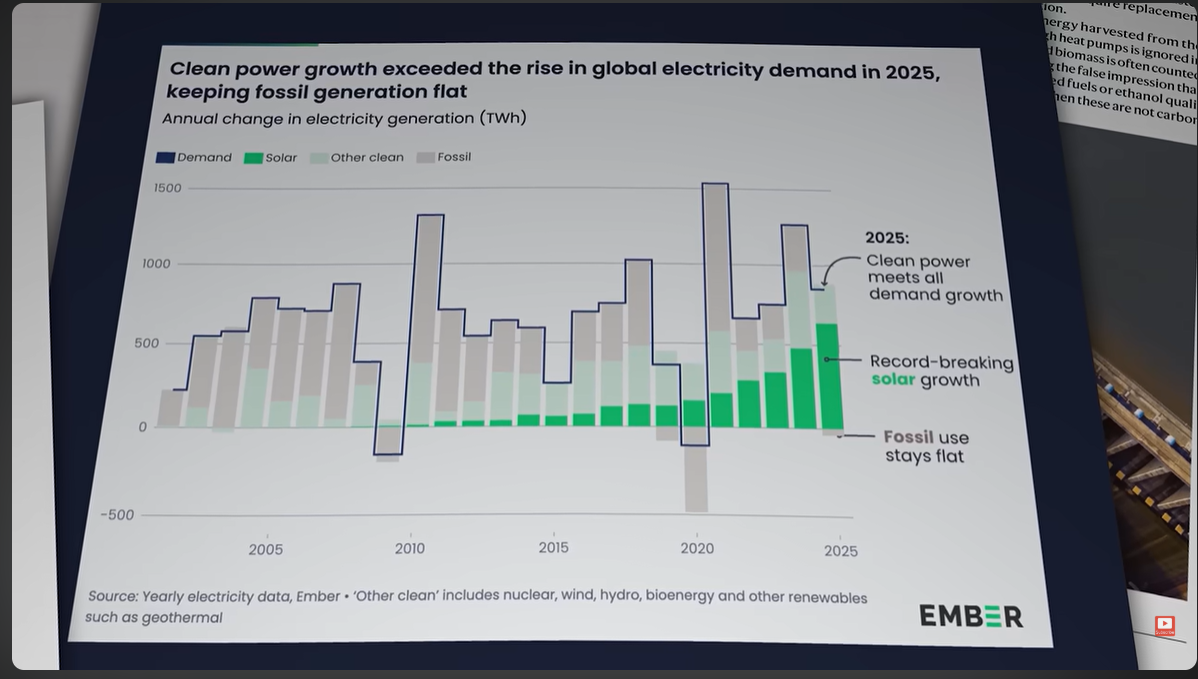
The host, Dave Borlace discusses how solar installation has vastly exceeded projections for many years and battery prices have fallen by 90% in the last 15 years. He mentions that (paraphrase)
~~”With renewables electricity becomes a manufactured product instead of an extractive fuel product, and manufactured technologies follow a learning curve, getting cheaper with scale and deployment and more deployment drives further cost reductions, while fossil fuels extraction gets harder to reach and more expensive over time as the easier deposits are mined out. Global investment in renewables is now roughly double fossil fuels.” — “Fossil is unique in scale, accounting for about 90% of the CO2 problem (vs. deforestation, wildfires, and soil cultivation mainly), and is uniquely simple to describe and deal with as it is a one way transfer of carbon from the lithosphere to the atmosphere directly by humans”~~
Direct quote from 11:15-12:05 in the video:
“But I do think there’s something quite compelling about measuring progress by practical system replacement rather than simply atmospheric outcomes. Because in the real world it’s looking more and more like the climate emergency won’t be solved by fixating on temperature targets. To the extent that it can be solved it’ll likely be achieved via infrastructure. If we become convinced that the situation is hopeless then political momentum collapses, investment collapses, and public engagement collapses. But according to almost every major energy analysis published over the last few years, the clean energy transition is very clearly not collapsing despite the best efforts of certain political administrations. In fact in most sectors it’s accelerating. The real question now is whether it can accelerate fast enough.”
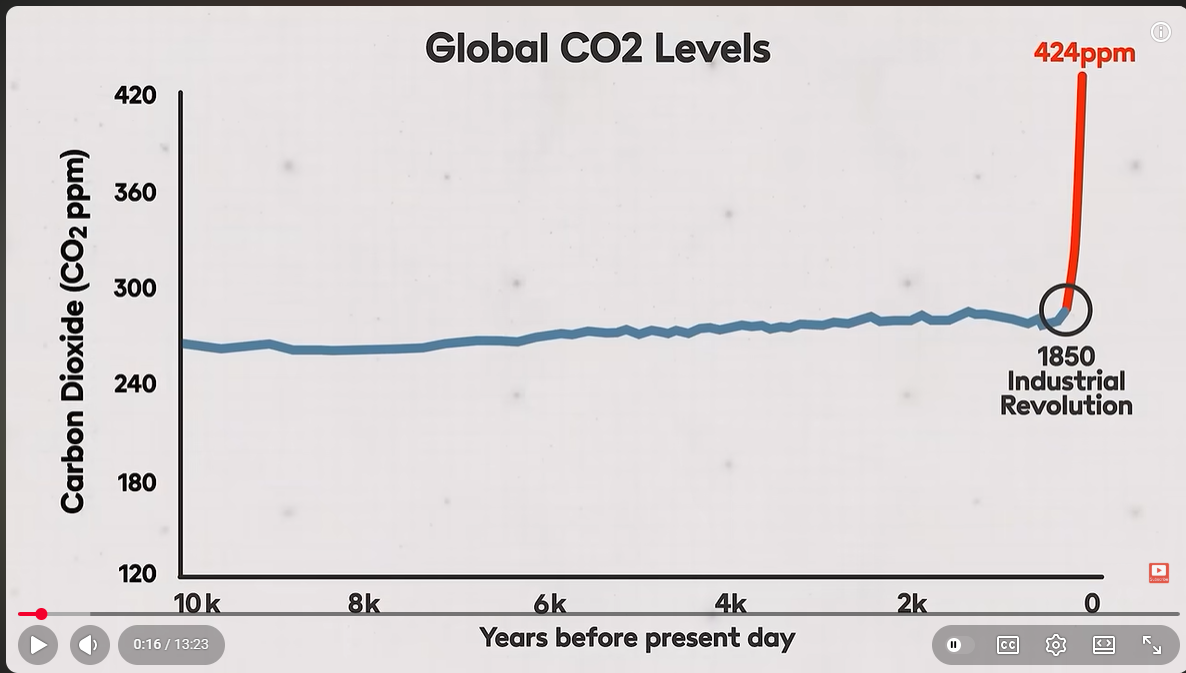
Finally here’s a chart for the uninitiated of CO2 concentrations from the last ice ages to now: